Art as a form of presence
Art isn’t escape — it’s presence. The gesture that says “I’m here”, even in silence.

Where the gesture remains, even after you leave.
“Art does not reproduce the visible; it makes it visible.” — Paul Klee
Some people paint to escape.
I paint to stay.
Art, deep down, is a form of presence — not representation.
It’s the gesture that says, “I’m here”, even when words fail.
When you paint, write, or sculpt, you’re suspending time.
Not to run away from the world, but to touch it differently — through your hands, your gaze, your silence.
Art doesn’t solve anything.
But it gives shape to what we feel, and sometimes, that’s enough.
Being present isn’t just being somewhere.
It’s being whole in the moment — body, breath, color.
And art might be the last place where that’s still possible.
👉 Café conclusion: to create is to say “I’m still here”, even when everything else goes quiet.

When painting asks for silence
When painting asks for silence, gesture learns to listen before it speaks.
Silence has color too.
“There’s a moment before every gesture — that’s where painting breathes.” — HMad
Some days, the studio asks for silence.
Not the comfortable kind, but the heavy one — the silence that forces you to stop.
The city’s noise stays outside, and even the brushes seem to wait for something you can’t name.
You open a tube of paint, but it’s not color you’re looking for — it’s the air between colors.
Painting sometimes asks for pause.
It wants time to listen to what you haven’t said yet.
And if you insist on rushing the gesture, it goes quiet.
There’s humility in accepting that silence.
Because, really, that’s where the work begins — before it exists, before it’s yours.
👉 Café conclusion: silence is a tool too — it just doesn’t fit in the paint box.

The power of emptiness in visual arts
Emptiness isn’t absence — it’s where art breathes.

Where silence becomes visible.
“Nothing is not a hole; it’s a field of possibilities.” — John Cage
Some people fear emptiness — the silence, the blank space, the pause.
But in visual arts, emptiness is anything but absence: it’s the place where the work breathes.
Malevich painted his White on White as if to say, “I no longer need anything for something to exist.”
Rothko immersed us in color fields that are really portals of silence.
And Agnes Martin proved that delicacy can be as radical as the most violent gesture.
Emptiness isn’t a lack of expression.
It’s the moment before the word, before the color — that fragile instant when the eye is still learning how to see.
In the end, emptiness is where everything begins.
Without it, gesture has nowhere to land, and thought has nowhere to echo.
👉 Café conclusion: emptiness isn’t the opposite of art — it’s its breath.
Before the first brushstroke
Painting doesn’t start on the canvas, but in the silence that prepares the space for it to happen.
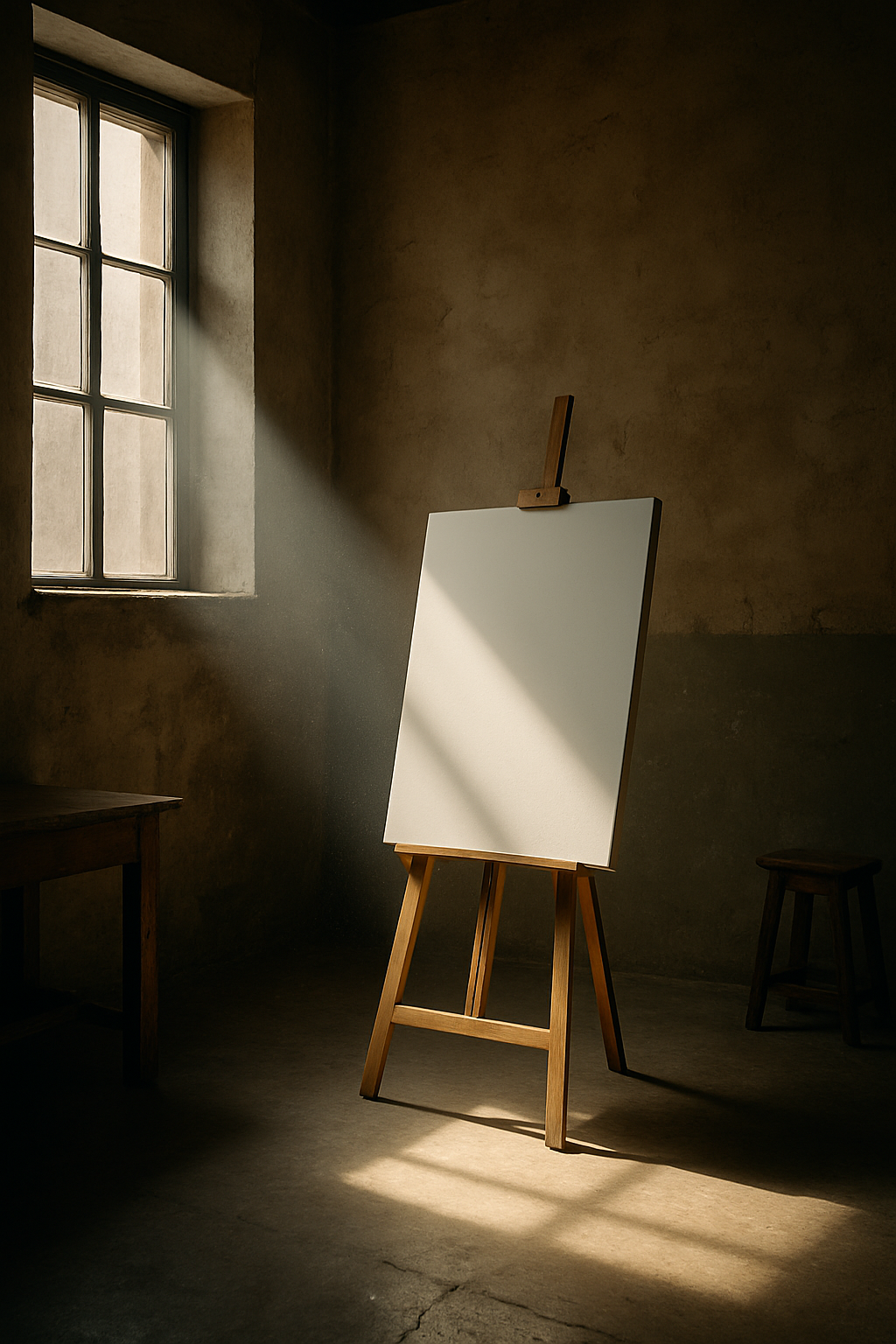
Silence before creation.
“It is not the painter who chooses the painting, it is the painting that chooses the painter.” — Georges Braque
Most people think a painting starts the moment color hits canvas. As if it were instant magic: paint → canvas → artwork.
For me, it starts much earlier. In silence. In emptiness. In that invisible space where the work decides whether it wants to be born.
What comes first
Every series demands its own logic. I’ve seen canvases turn into fragments of memory, into bodies moving, into landscapes to explore. I never repeat the path. Each exhibition forces me to unlearn and invent a new way of thinking.
That’s the risk: walking into a forest I’ve never crossed, with no map, no promise of a way out. And yet — stubbornly hoping there will be light.
Order and chaos at the table
I can sketch plans, fill notebooks with ideas, rehearse in my head. But when the moment comes: color chooses its destiny, gesture takes over, the painting responds. And me? I follow.
It’s in that tense balance between order and chaos that the work reveals itself — and often surprises me more than it surprises you.
The real secret
Maybe the secret is not mastering painting. Maybe it’s just this: preparing the space so that it can happen. Like clearing a path and waiting for the light to break through.
👉 Café conclusion: painting doesn’t begin on canvas, but in the space we open for it to exist. And in December, I’ll be opening that space with you.

How to choose between canvas and paper: a simple guide not to get lost in the art shop
A quick, witty, and direct guide to avoid getting lost between canvases and papers at the art shop.

“Art does not reproduce what we see. It makes us see.” — Paul Klee
You walk into the art store. The plan was simple: grab “something to paint on.” Half an hour later you’re still frozen between canvases, smooth papers, textured papers, thick, thin, cheap, pricey… and already considering pretending you forgot your wallet.
Canvas or paper? That is the question
The dilemma is old. Canvas has prestige, instantly screams “serious art.” Paper is democratic, versatile, slips into any folder. Both have their charm — but it helps to know what each is good for.
When to choose canvas
You want your piece to last for decades without yellowing.
You’re working with oil or acrylic (paper suffers with that).
You love the irregular texture that gives depth to color.
You want to hang the work directly, no frame needed.
You need to feel like a “studio painter,” even if just on Sundays.
When to choose paper
You like experimenting with watercolor, gouache, graphite, or pastels.
You enjoy the freedom to tear, glue, fold.
You don’t have room to store canvases (paper stacks).
You want something cheaper for tests or quick series.
You know Picasso sketched on paper too — and it worked out fine for him.
Survival tip in the art store
If you still freeze in the weight-and-texture aisle: buy both. Worst case, you’ll discover you’re a mixed-media artist without even trying.
Closing
👉 The artsy moral of the tale: canvas impresses, paper frees. It’s like choosing between wine and coffee — each has its moment.

Minimalist sculpture: simple or deceptive?
Minimalist sculpture may look simple, but it hides radical choices and an almost obsessive focus on the essential.
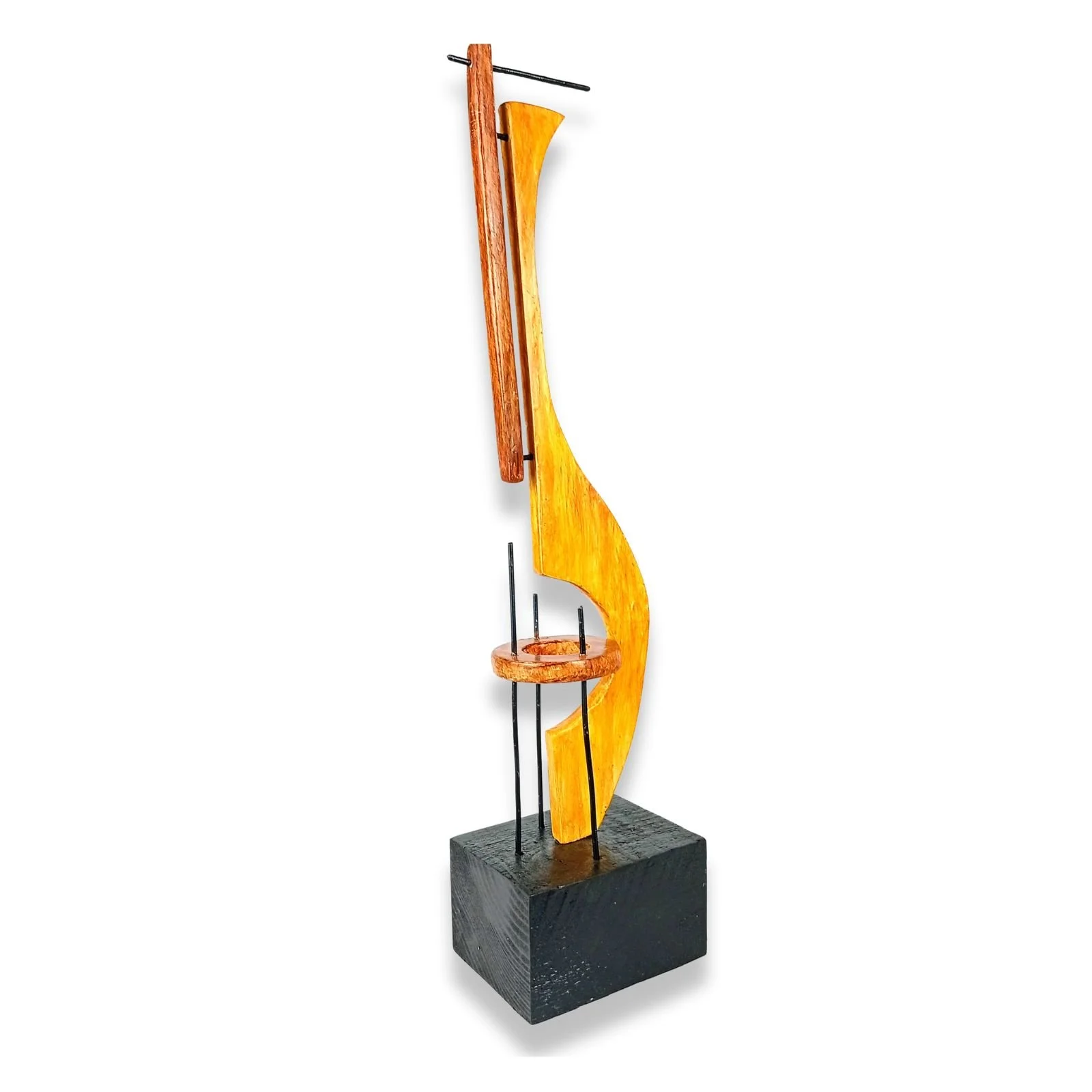
Refined lines, silence in wood and iron.
Refined lines, silence in wood and iron.
“Less is more.” — Ludwig Mies van der Rohe
Minimalist sculpture may seem, at first glance, simple. Clean lines, stripped forms, no unnecessary decoration. But is it really that straightforward?
👉 The illusion of simplicity
A casual glance might think: “Anyone could do this.” Yet the hard part is reaching the essential without falling into monotony. Cutting, reducing, refining… until only what truly matters remains.
👉 The dialogue between void and form
In sculpture, empty space isn’t absence — it’s part of the work. The void shapes the volume, creates tension, and suggests presences that are not there but can almost be felt.
👉 Why deceptive?
Because behind every “simple” line lies a set of radical choices: what stays and what disappears. Formal economy demands an almost obsessive attention.
👉 Want to see how minimalism takes shape?
Browse the In the gallery to discover the full collection.
And if you’d like to explore the pieces (still) available for purchase, visit the Minimal Abstract Figurativism page
👉 The café conclusion
Minimalism isn’t laziness. It’s risk, precision, and trust in letting the essential speak for itself.

5 things you should never say to an artist
Five seemingly innocent phrases that can make an artist want to throw the brush out the window.

“An artist is someone who sells what he no longer has.” — Picasso (with his trademark irony)
We all know that friend who thinks they’re being nice… but says the worst possible thing.
To avoid deadly stares and awkward silence, here are 5 gems you should never say to an artist:
“Can you actually make a living from this?”
(Thanks for the concern… now excuse me while I eat my canvas with acrylic sauce.)“But how long did it take you?”
(As if the value was in the stopwatch and not the creation. Spoiler: this isn’t Uber Eats.)“My kid could do that too.”
(Congrats to your kid. Maybe they’re a genius. Or maybe you just don’t get it.)“Can you give me a discount?”
(Sure, and you happily take half your paycheck, right?)“I could do that myself.”
(Then… why didn’t you?)
👉 The no-fluff takeaway
Respect the artist, enjoy the work — and if you can’t think of anything smart to say, just compliment the color.

Picasso: genius or master illusionist?
Picasso: undeniable genius or master illusionist? Between the revolutionary artist and the salesman of his own myth, the truth might be somewhere in between.

Pablo Picasso, 1950s. Photograph by André Villers.
“It took me four years to paint like Raphael, but a lifetime to paint like a child.” — Pablo Picasso
Was Picasso a genius or simply a brilliant illusionist?
The question stings, because it shakes the pedestal we’ve placed him on.
On one side, the undeniable genius:
He reinvented himself through multiple styles, from the Blue Period to Cubism.
He broke conventions and opened the doors to what we now call contemporary art.
He created iconic works that even people who dislike art still recognize.
On the other, the master illusionist:
He knew how to provoke, shock and grab attention like few others.
He sold himself (and us) the idea that any line he drew was art.
He turned his persona into a spectacle — and that also has a price.
Gertrude Stein, who knew him in Paris, once said:
“He is Spanish, you know… and for a Spaniard, the world is a stage.”
And the critic Robert Hughes put it bluntly:
“Picasso was as much a salesman as a painter. But maybe that was the secret of his greatness.”
👉 What remains is this delicious ambiguity: Picasso was both artist and performer, painter and salesman, genius and illusionist. Maybe that’s what makes him eternal — you simply can’t put him in a single box.
And you? When you look at a Picasso, do you see genius, trickery, or both at once?
👉 The artsy moral of the tale
Picasso may have sold illusions, but maybe that’s his greatest talent: convincing us that art is more than paint on canvas — it’s also the story we choose to believe.

What is art, really?
What is art, really?
It’s not just galleries and white walls.
Sometimes it’s a doodle on a napkin, the silence between two notes… or simply paint-stained hands and hot coffee by your side.

Paint and coffee — the official fuels of creative madness.
“Art is what makes your heart beat faster. Or slower. But never indifferent.” — Anonymous
Art isn’t just museums and white walls.
Art can be the doodle on a napkin, the blurry photo that ends up having more soul than the “perfect” one, or even the silence between two guitar notes.
It’s personal, but also universal.
It’s serious, but it can also be brilliant nonsense.
It’s hard work, but also a stroke of luck.
👉 The trick? It doesn’t need a single definition. What it needs is space for you to breathe and feel.
👉 Bottom line, with paint still wet
Art is anything that makes you stop for a second and think: “Hold on… that moved me.”